

2026 Outlook

What Experts Around the World Are Predicting (ICC Blog # 137)
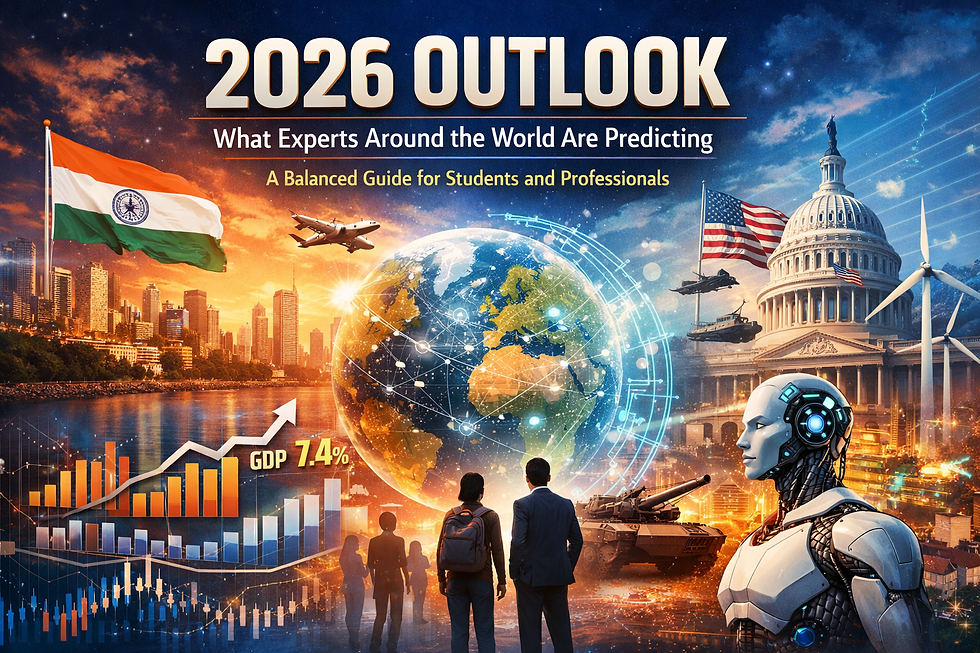
As we have entered into 2026, forecasts from leading think tanks, economic institutions, and risk consultancies are painting a vivid picture of the year ahead, highlighting geopolitical shifts, economic trajectories, and technological disruptions that could reshape careers and opportunities. Drawing from diverse sources, this guide offers a balanced perspective tailored for students and professionals in India, helping you navigate these changes with clarity and foresight.
2026: A Global Year of Transition & Not Collapse
Experts across various organizations describe 2026 as a period of significant transition rather than outright crisis, underscoring its importance for strategic career planning, business decisions, and educational focus. The global economy demonstrates resilience amid challenges, with the Organisation for Economic Co-operation and Development projecting steady yet moderated growth. Specifically, worldwide GDP is anticipated to ease from approximately 3.3 percent in 2024 to 3.2 percent in 2025, before settling at around 2.9 percent in 2026, as inflation continues to cool but lingering geopolitical tensions and elevated public debt pose ongoing hurdles. This trajectory, while not explosive, signals sustained economic activity that typically supports job creation and investment flows. However, other projections introduce notes of caution; for instance, analyses from United Nations economists indicate a potential mild slowdown in key economies like India, where GDP growth might hold strong at about 7.4 percent for the fiscal year 2026, building on robust performance in prior periods. For individuals charting their professional paths, this implies that employment opportunities will persist, though the rhythm of expansion could influence outcomes—sectors intertwined with the digital economy and resilient global supply chains are poised to outpace more conventional industries, offering fertile ground for skill development and career advancement.
Geopolitical Risks Are Real — But Not Monolithic
Amid this economic backdrop, geopolitical uncertainties loom large, though they manifest in varied and interconnected ways rather than as a singular threat. The Eurasia Group, a prominent political risk consultancy, positions the unfolding political revolution in the United States as the foremost risk for 2026, suggesting that transformations in U.S. governance could unleash ripple effects worldwide, rendering the nation less predictable and reliable on the global stage. This perspective is echoed in their detailed report, which warns that the United States is effectively dismantling its own established international order, emerging as the primary driver of global instability this year. Complementing this top concern are additional hazards outlined in their analysis, such as China's accelerating dominance in advanced technologies, escalating hybrid confrontations between Russia and NATO allies, intensifying pressures on essential resources like water that could fuel conflicts, and persistent trade frictions within North America that disrupt established agreements.

Meanwhile, insights from the World Economic Forum reveal a broader erosion of large-scale global cooperation, with ties in trade, climate action, and peacekeeping fragmenting in favor of smaller, interest-aligned coalitions among nations. This shift complicates international coordination, impacting students pursuing degrees in international relations by highlighting the need for nuanced understanding of multipolar dynamics, while professionals in cross-border businesses and institutions engaged in global programs must adapt to a landscape where alliances are more fluid and collaborative efforts harder to sustain.
Technology: The Double-Edged Sword of 2026
Technology, particularly artificial intelligence, stands out as both a catalyst for progress and a source of potential volatility in the coming year. Substantial investments in AI and supporting data infrastructure are expected to propel innovation forward, invigorating fields such as finance, healthcare, and manufacturing with new efficiencies and breakthroughs. Yet, this surge carries undercurrents of risk, as some investors caution that the escalating costs associated with AI—from expansive data centers and heightened energy demands to broader tech expenditures—could ignite inflationary pressures, potentially tempering overall economic momentum if left unchecked. For those building careers, this duality underscores the value of acquiring expertise in areas like AI and machine learning, data analytics, cybersecurity, and cloud computing, which are likely to see surging demand as organizations seek to harness these tools while mitigating their downsides.
Regional Outlooks — Why 2026 Outlook Matters for India
Zooming in on regional dynamics, India emerges as a beacon of relative strength in 2026, with projections affirming its status as one of the world's fastest-growing major economies at an estimated 7.4 percent for the fiscal year, positioning it as a vibrant hub for career opportunities and investments compared to slower expansions in certain Western markets. This optimism extends to broader emerging markets, where a recent McKinsey survey captures a sense of positivity among respondents, particularly in Greater China and India, who express the highest confidence in improving economic conditions and view evolving trade policies not merely as obstacles but as avenues for business growth and expansion. Such trends reinforce India's appeal as a focal point for talent and capital, encouraging a proactive approach to leveraging these advantages.
What This Means for Students and Professionals
Translating these global and regional insights into actionable steps, students would be wise to gravitate toward forward-looking disciplines that align with emerging demands, such as artificial intelligence and machine learning, data science, cybersecurity, renewable energy, economics, and international relations, while cultivating interdisciplinary abilities that merge technical proficiency with insights from business or policy realms. Professionals, in turn, should prioritize adaptability in the face of geopolitical flux and economic variability, committing to ongoing skill enhancements and emphasizing trends like sustainability initiatives, digital transformations, and efforts toward financial inclusion to remain competitive. Educational institutions play a pivotal role here, by refreshing curricula to incorporate literacy in global risks, competencies for the digital economy, and training in leadership, alongside forging international partnerships that facilitate cross-border learning experiences and internships in high-growth sectors.
2026: A Year of Transition
In essence, the overarching themes for 2026 reveal a global economy that sustains growth albeit at a more uneven and moderated pace, geopolitical landscapes marked by fragmented cooperation and pivotal shifts, technological advancements driven by AI that promise expansion yet introduce inflationary and volatile elements, and a spotlight on India's robust performance as one of the planet's top growth engines. Overall, the year promises neither serenity nor catastrophe but rather a phase of profound structural evolution, brimming with prospects for those equipped with essential skills, flexibility, and an attuned global perspective.
Resources and Further Reading
For deeper exploration, consider the OECD Economic Outlook 2026 for comprehensive economic projections, the Eurasia Group Top Risks 2026 report for in-depth geopolitical analysis, the World Economic Forum's insights on global cooperation via Reuters coverage, and The Economic Times articles on India's growth trajectories.


Comments