

American Higher Education in 2026: What Indian Students Actually Need to Know

Updated: Aug 5
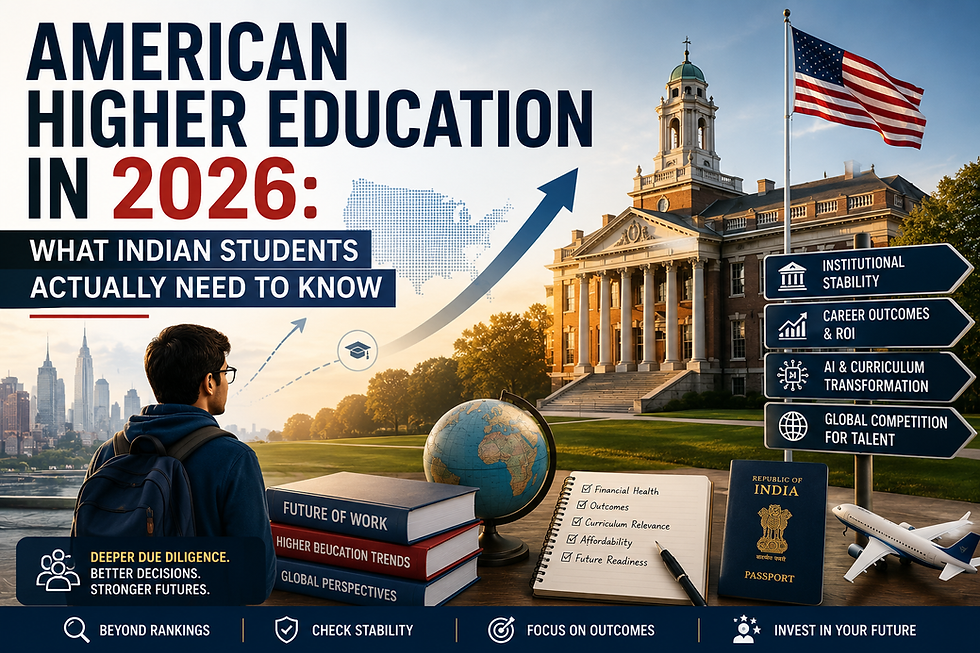
Every few months, headlines about American higher education focus on shrinking enrolments, financially strained colleges, and mounting student debt. For an Indian family weighing a six- or seven-figure investment in a US degree, that coverage can be hard to interpret. It also tends to miss the more useful story.
The more accurate and more useful framing is this: the US higher education system is not shrinking uniformly. It is going through one of the most significant structural transformations in its history. Understanding why this transformation is happening, and how it is reshaping the system, matters far more to an applicant than any single headline does. It changes which institutions you should be looking at, and why.
The System, in Numbers
Before examining the trends reshaping American higher education, it helps to understand the scale of the system itself. The numbers tell a more nuanced story than many headlines suggest.

The United States had approximately 5,626 Title IV institutions (colleges and universities eligible to participate in federal student aid programmes) in the 2024-25 academic year, including around 2,600 four-year institutions awarding bachelor's degrees or higher. This is down from more than 7,000 institutions in 2010-11, a decline of about one-fifth over the past 14 years reflecting a long period of consolidation among smaller, tuition-dependent, and financially weaker colleges.
Total enrolment across the U.S. higher education system stood at approximately 19.25 million students in the 2024–25 academic year. While this makes it one of the world's largest higher education systems, it is significantly smaller than India's, which enrolled an estimated 44.6 million students (4.46 crore) according to the provisional AISHE 2022–23 report. Yet despite its smaller scale, the United States remains the world's leading destination for international students, reflecting the global reputation of its universities, research ecosystem, innovation ecosystem, and career opportunities. While India hosts around 50,000 international students, the United States attracts more than 1.17 million international students annually, over twenty times as many.
International student enrolment reached a record 1,177,766 students in 2024–25, accounting for approximately 6.1% of total enrolment and representing a 5% increase over the previous year.
India became the largest source country of international students in the United States, with 363,019 Indian students enrolled in 2024–25, a 10% increase year-on-year. Indian students now account for about 31% of all international students in the country. China ranked second, with 265,919 students, a 4% decline from the previous year. Together, India and China account for more than half of all international students studying in the United States.
International students contributed nearly US$55 billion to the U.S. economy in 2024 and supported more than 355,000 American jobs, highlighting their growing economic importance to universities and local communities alike.
However, the forward-looking indicators are less encouraging. While total international enrolment reached a record high, new international student enrolment (first-time students) declined by about 7% in 2024–25, followed by a further 17% decline in the Fall 2025 Snapshot. Universities cited visa-processing delays, travel restrictions, and policy uncertainty as the primary reasons behind the slowdown.
The takeaway
These figures reveal a system that remains extraordinarily large, globally influential, and deeply attractive to international students. Indian students, in particular, are no longer a marginal presence they are now the largest international student community in the United States.
At the same time, the data points to an important shift. While overall enrolment remains strong, the slowdown in new international student enrolment, combined with demographic pressures, rising costs, and financial strain on many institutions, suggests that American higher education is entering a new phase of structural transformation. The opportunity to study in the United States remains significant, but choosing the right university now requires greater due diligence than ever before.
This didn't start yesterday
The forces reshaping US higher education have been building for close to two decades, not months. A rough timeline helps put the current moment in context:
2008 financial crisis : That set off a wave of affordability concerns that never fully went away.
Early 2010s : Student debt in the US crossed the $1 trillion mark and kept climbing.
Around 2010–2011 : The overall US college enrolment peaked and then began a slow decline, concentrated in undergraduate programmes.
The "enrolment cliff": The demographers had flagged for years that falling US birth rates after 2008 would produce a sharp drop in the number of domestic college-age students, with the effect landing hardest around 2025–2026.
2020–2022 (COVID-19): This accelerated the shift toward online learning, shorter credentials, and much harder questions about whether a degree is "worth it."
Since 2022 (AI) : AI has added a new disruptive force, pushing universities to rethink curricula, assessment, and what employers will actually expect from graduates.
None of these are new developments. What's new is that they are all landing on the system at roughly the same time.
Why several trends are converging at once
These are trends that are individually manageable but are collectively pushing every US institution to reconsider its business model:
Fewer domestic college-age students to enrol.
Rising operating costs for universities.
Real financial pressure on tuition-dependent colleges.
Sharper global competition for international students which affects Indian applicants directly.
Growing demand from students and parents for demonstrable career outcomes and ROI.
AI reshaping what skills employers actually want.
An increasingly public, political debate about the purpose and value of a university degree.
The system is splitting into two tiers
The clearest pattern emerging from all of this is institutional polarization.
At one end sit the globally recognized research universities strong endowments, deep research funding, and enduring student demand. These institutions continue to pull in top faculty, research grants, philanthropic funding, and international talent largely independent of these broader trends.
At the other end are smaller, tuition-dependent colleges facing enrolment declines, budget cuts, mergers, and in some cases closure.
The middle tier is where the real risk is. Universities that can't clearly show value, affordability, or strong employment outcomes are the ones struggling to compete — and, over a four-year degree cycle, potentially the ones facing financial instability while your child is still enrolled there.
This is the single most practical takeaway from the whole trend: where an institution sits in this polarization matters more today than it did ten years ago. A well-known name is no longer, by itself, a guarantee of institutional stability.
The retail industry offers a useful analogy
This transformation resembles what happened to American retail over the past two decades. E-commerce did not eliminate retail overnight it reshaped it. Some retailers invested in digital capability and came out stronger. Others merged or reinvented themselves. Some that didn't adapt eventually closed.
US higher education appears to be following the same arc: not disappearing, but restructuring around new economic, technological, and demographic realities. Some institutions will emerge stronger and more selective. Others will consolidate or shut down. The skill, for an applicant, is telling the two apart before you enrol, not after.
What this actually means for your application strategy
Given all this, here's how Indian students and parents should adjust their approach when evaluating US universities:
1. Look past brand name to institutional financial health. Endowment size, research funding trends, and multi-year enrolment data are now as relevant to your due diligence as rankings. A university under financial stress can cut programmes, raise fees mid-course, or in extreme cases close disrupting a degree already in progress.
2. Weight career outcomes and ROI data heavily. Institutions in the "squeezed middle" often compensate with aggressive marketing rather than strong outcomes. Ask for verifiable, program-specific placement and salary data not general institutional claims.
3. Understand that international student demand is now a competitive asset for universities, not just an opportunity for you. As domestic enrolment shrinks, many US institutions are actively competing for international students, including Indians. This can mean more scholarship activity and course flexibility at some schools but also more aggressive recruiting from institutions that most need the revenue. Read that enthusiasm with appropriate scrutiny.
4. Factor AI-related curriculum change into your programme choice. Universities investing seriously in updating curricula for an AI-influenced job market are signalling long-term relevance. Ask what has changed in a programme's curriculum in the last two to three years, and why.
5. Don't mistake a middle-tier institution's marketing confidence for stability. The pressure on this tier is exactly why marketing spend and messaging often increase even as underlying institutional health weakens. Verify claims independently accreditation status, faculty retention, and financial disclosures where available.
The bottom line
The more useful question isn't "Is American higher education in decline?" It's "What's actually changing, and what does that mean for where I choose to study?"
This transformation didn't begin yesterday. It has been building for close to two decades, and its effects are now clearly visible in enrolment and financial data across the sector. For Indian students and families, that's not a reason to rule out the US as a study destination it's a reason to apply more rigorous, outcome-focused due diligence than the brand-name approach that worked a decade ago.
This piece is part of India Career Centre's ongoing coverage of global higher education trends and their implications for Indian students. For personalised guidance on evaluating US university options, reach out to ICC.
About the Author:
Dr SP Mishra is the Founder of India Career Centre, a Hyderabad-based career guidance, study-abroad consulting and educational research organisation. He writes and speaks on career decision-making, higher education, skills, employability and the future of work in India. Also hosts the India Career Centre Podcast. Connect on LinkedIn.


Comments