

Beyond English How India Can Develop a Global Language Strategy for Youth (ICC # 162)

Updated: Apr 6
India’s youth stand at a crossroads where language skills can shape their future in profound ways. English has long been the dominant global language, offering access to education, technology, and international opportunities. Yet, relying solely on English limits the potential of millions of young Indians who speak diverse regional languages. To truly empower its youth, India needs a global language strategy that goes beyond English and embraces multilingualism, cultural diversity, and practical skills for global engagement.

The Current Language Landscape in India
India is home to over 22 officially recognized languages and hundreds of dialects. Despite this rich linguistic diversity, English remains the primary language of higher education, business, and technology. This dominance creates a divide:
Access gap: Students from rural or non-English-speaking backgrounds often struggle to compete.
Cultural disconnect: Overemphasis on English can erode local languages and cultural identity.
Limited global reach: English alone may not be enough in a world where other languages like Mandarin, Spanish, and Arabic are gaining importance.
The challenge is clear: how can India equip its youth with language skills that open global doors while preserving its linguistic heritage?
Why English Alone Is Not Enough
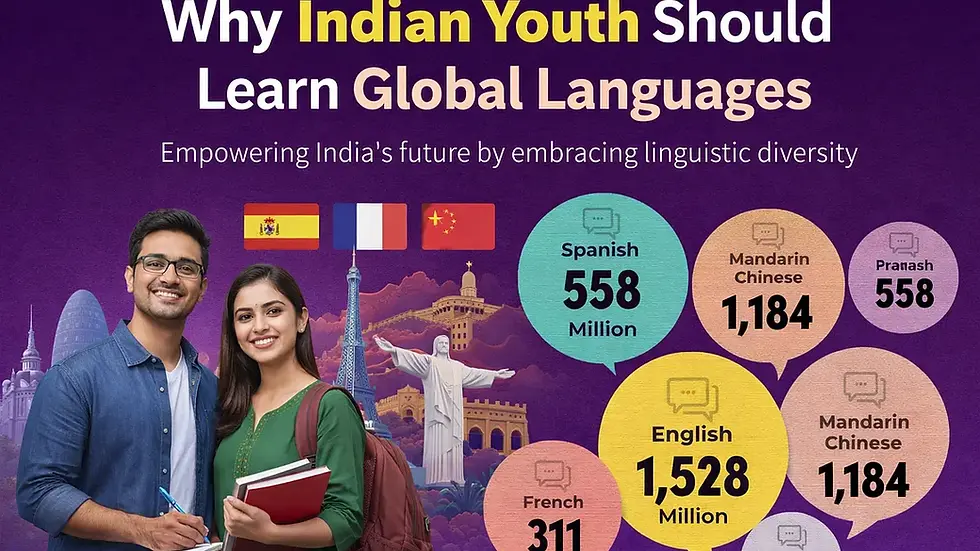
English has been a valuable tool for India’s integration into the global economy. However, the world is changing rapidly:
Emerging global players: Countries like China, Spain, and the Arab world are expanding their influence.
Multilingual markets: Businesses increasingly require employees who can communicate in multiple languages.
Cultural intelligence: Understanding languages beyond English fosters empathy and better international relations.
For example, Indian IT companies expanding into Latin America benefit from employees who speak Spanish or Portuguese. Similarly, knowledge of Mandarin can open doors in China’s vast market. English proficiency remains important but should be part of a broader language toolkit.
Building a Multilingual Education Framework
A global language strategy must start with education. Schools and universities can play a pivotal role by:
Introducing multiple foreign languages early: Offering options like Mandarin, Spanish, French, and Arabic alongside English.
Strengthening regional language education: Ensuring students maintain fluency in their mother tongue.
Using technology for language learning: Apps, online courses, and virtual exchanges can make learning accessible and engaging.
For instance, some Indian schools have started pilot programs teaching Mandarin from primary grades, showing promising results in student engagement and language retention.
Encouraging Language Learning Through Policy
Government policies can support multilingualism by:
Incentivizing language skills in job markets: Employers could prioritize candidates with multiple language proficiencies.
Funding language training programs: Especially in underserved areas.
Promoting cultural exchange programs: Scholarships and partnerships with foreign institutions to immerse youth in different languages and cultures.
The success of the Indian Council for Cultural Relations (ICCR) in promoting Indian languages abroad can serve as a model for reciprocal efforts to bring global languages into India.
Leveraging Technology and Media
Technology offers powerful tools to expand language learning beyond classrooms:
Language learning apps: Platforms like Duolingo and Babbel can be localized for Indian users.
Online content creation: Encouraging youth to create blogs, videos, and podcasts in multiple languages.
Virtual reality and AI: Immersive experiences can simulate real-world conversations and cultural contexts.
Media also plays a role. Popular films, music, and literature in various languages can spark interest and provide informal learning opportunities.
The Role of Parents and Communities
Language learning thrives when supported at home and in communities. Parents can:
Encourage children to speak and read in their mother tongue.
Support learning additional languages through resources and motivation.
Participate in community language events and cultural festivals.
Communities can organize language clubs, cultural workshops, and storytelling sessions to keep languages vibrant and relevant.
Preparing Youth for Global Opportunities
A global language strategy should align with career and personal development goals:
Language skills for specific industries: Tourism, diplomacy, international business, and technology all benefit from multilingual employees.
Soft skills development: Communication, cultural sensitivity, and adaptability complement language proficiency.
Certification and recognition: Standardized language tests can validate skills for employers and educational institutions.
For example, the Indian government’s Skill India initiative could integrate language training modules tailored to different sectors.
Challenges to Overcome
Implementing a global language strategy faces obstacles:
Resource constraints: Many schools lack trained language teachers and materials.
Socioeconomic disparities: Access to quality language education varies widely.
Resistance to change: Some stakeholders may prioritize English exclusively or undervalue regional languages.
Addressing these requires coordinated efforts from government, educators, private sector, and civil society.
Moving Forward with a Clear Vision
India’s youth deserve a language strategy that reflects the country’s diversity and global ambitions. This means:
Recognizing the value of multiple languages, not just English.
Creating inclusive policies that reach all regions and communities.
Embracing technology and innovation in language education.
Fostering a culture that celebrates linguistic diversity as a strength.
By doing so, India can prepare its young people to thrive in a connected world while honoring their roots.
Conclusion: Embracing Multilingualism for a Brighter Future
In conclusion, a robust language strategy is essential for India’s youth. It should not only focus on English but also promote multilingualism. This approach will empower young people to navigate a global landscape while preserving their cultural identities. I believe that by embracing this vision, we can foster real career growth and clarity for the next generation.
In this context, the phrase India Career Centre encapsulates the goal of guiding students and professionals toward informed decisions in their education and career paths.

Comments