

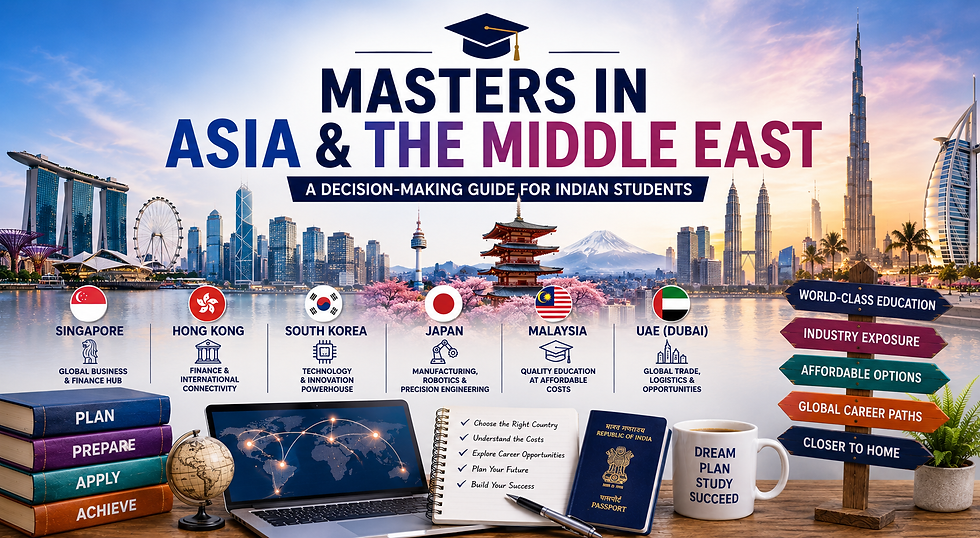
Masters in Asia & the Middle East: A Decision-Making Guide for Indian Students

Updated: Jun 10
Introduction
Over the past decade, Asia and the Middle East have emerged as attractive destinations for Indian students seeking international education. Countries such as Singapore, Hong Kong, Japan, South Korea, Malaysia, and the United Arab Emirates offer globally recognized qualifications, industry-focused programs, modern infrastructure, and growing employment opportunities.
While these destinations may not always receive the same attention as the USA, UK, Canada, or Australia, they often provide a compelling combination of affordability, geographic proximity, strong industry ecosystems, and faster application processes.
This guide is designed to help students evaluate these destinations objectively and make informed decisions based on career goals, financial realities, and long-term aspirations.
Three Things That Matter Most
Before choosing a destination, focus on three fundamental questions:
1. What Career Opportunities Will Be Available After Graduation?
The primary purpose of a Master's degree is to improve career prospects. Understanding industry demand and employment opportunities should be a priority.
2. What Is the Total Investment?
Evaluate the complete cost of education, including tuition, accommodation, living expenses, insurance, and travel.
3. How Well Does the Destination Align With My Goals?
Some destinations are stronger in finance, others in technology, manufacturing, logistics, or research. The best destination depends on your aspirations.
Key Questions Before You Apply
Academic Fit
What specialization do I want to pursue?
Which countries are strongest in my chosen field?
Do I prefer a research-oriented or industry-oriented curriculum?
Career Fit
What type of role do I want after graduation?
Which industries are growing in the destination country?
Are internships and industry projects integrated into the program?
Financial Fit
How much can my family comfortably invest?
What is the likely return on investment?
Can I manage if part-time opportunities are limited?
Personal Fit
Am I comfortable living in a multicultural environment?
Am I willing to learn a new language if required?
How important is proximity to India?
Cost of Studying in Asia & the Middle East
The figures below represent the approximate total cost of tuition, accommodation, living expenses, and student-related costs for the complete duration of the program. Actual costs vary by institution, city, lifestyle, and exchange rates.
Destination | Typical Program Duration | Approximate Total Cost (Entire Program) |
Singapore | 1 Year | ₹18 Lakh |
Malaysia | 1–2 Years | ₹8.5–15 Lakh |
Dubai (UAE) | 1–2 Years | ₹20 Lakh |
South Korea | 1–2 Years | ₹15–30 Lakh* |
Hong Kong | 1–2 Years | ₹18–30 Lakh* |
Japan | 1–2 Years | ₹20–35 Lakh* |
*Approximate market ranges. Students should verify university-specific costs before applying.
Duration of Master's Programs
Destination | Typical Duration |
Singapore | 1 Year |
Malaysia | 1–2 Years |
Dubai (UAE) | 1–2 Years |
South Korea | 1–2 Years |
Hong Kong | 1–2 Years |
Japan | 1–2 Years |
Shorter programs reduce overall costs and allow earlier entry into the workforce, while longer programs often provide greater opportunities for research, internships, and networking.
Application & Visa Timelines
One advantage of many Asian destinations is their relatively faster processing times compared to several Western destinations.
Destination | Typical Processing Time |
Singapore | 3 Months |
Malaysia | 3 Months |
Dubai (UAE) | 3 Months |
South Korea | 4–6 Months |
Hong Kong | 4–6 Months |
Japan | 4–6 Months |
|
|
Students should ideally begin planning 9–12 months before their intended intake.
Suggested Timeline
9–12 Months Before Intake
Explore universities and programs
Finalize specialization
Prepare for language proficiency tests
6–9 Months Before Intake
Submit applications
Prepare SOP, CV, and recommendation letters
Arrange finances
3–6 Months Before Intake
Receive admission offers
Apply for visa
Arrange accommodation
1–2 Months Before Departure
Book flights
Arrange insurance and banking
Prepare for relocation
Part-Time Work Opportunities During Study
Part-time employment opportunities vary significantly across Asian destinations and should not be viewed as the primary source of funding.
Destination | Work Rights | Approximate Annual Earning Potential |
Singapore | Limited | Limited |
Malaysia | Internship-focused opportunities | Limited |
Dubai (UAE) | Subject to approval | Limited |
South Korea | Up to 20 hrs/week | ₹5 Lakh per year |
Hong Kong | Limited/Program dependent | Moderate |
Japan | Up to 28 hrs/week (subject to regulations) | Moderate |
Students should plan their finances assuming that part-time work may not be immediately available.
Post-Study Work Opportunities
The opportunity to gain international work experience after graduation can significantly influence the return on investment.
Destination | Maximum Post-Study Work Opportunity |
South Korea | Up to 36 Months |
Singapore | Up to 12 Months (selected pathways) |
Malaysia | Up to 12 Months |
Dubai (UAE) | Limited and employer dependent |
Hong Kong | Up to 24 Months* |
Japan | Opportunities available through employment sponsorship pathways |
*Subject to prevailing immigration regulations.
Language Considerations
Language can be a significant differentiator in Asia.
Primarily English-Friendly Destinations
Singapore
Hong Kong
Malaysia
Dubai
Students can comfortably study, live, and work using English.
Destinations Where Local Language Significantly Improves Employability
Japan
Learning Japanese can substantially improve internship and employment opportunities.
South Korea
Korean language proficiency is often highly valued by employers.
Students planning long-term careers in these countries should strongly consider investing in language learning.
Choosing Based on Career Goals
Finance, Banking & FinTech
Strong Choices
Singapore
Hong Kong
Both are among Asia's leading financial centres and host regional headquarters of multinational corporations.
International Business & Management
Strong Choices
Singapore
Hong Kong
Dubai
These destinations offer strong exposure to global trade, consulting, logistics, and multinational business operations.
Technology, Electronics & Innovation
Strong Choices
South Korea
Japan
Singapore
Particularly suitable for students interested in:
Artificial Intelligence
Semiconductor Technology
Electronics
Robotics
Advanced Manufacturing
Logistics & Supply Chain Management
Strong Choices
Singapore
Hong Kong
Dubai
All three are major global transportation and logistics hubs.
Manufacturing & Industrial Engineering
Strong Choice
Japan
Japan remains one of the world's most advanced manufacturing economies and offers excellent opportunities in engineering and industrial systems.
Hospitality, Tourism & Aviation
Strong Choice
Dubai
Dubai's position as a global tourism and aviation hub creates significant opportunities in these sectors.
Affordable International Education
Strong Choice
Malaysia
Malaysia offers one of the lowest-cost international education pathways while still providing exposure to a multicultural environment.
Budget-Based Shortlisting
Budget Below ₹15 Lakh
Malaysia
Budget ₹15–25 Lakh
Singapore
Dubai
Hong Kong
South Korea
Budget Above ₹25 Lakh
Japan
Premium Singapore programs
Premium Hong Kong programs
Budget should be viewed as a starting point for shortlisting destinations rather than the sole basis for making a decision.
Who Should Consider Asia & the Middle East?
These destinations may be particularly suitable for students who:
Want international exposure at a lower overall cost
Prefer destinations closer to India
Are interested in finance, technology, logistics, manufacturing, or international business
Value strong industry connections and practical learning
Seek faster application and visa processes
Want exposure to rapidly growing Asian economies
Common Mistakes Students Make
Assuming all Asian destinations offer similar opportunities
Choosing solely based on affordability
Ignoring local language requirements
Overestimating part-time work opportunities
Not researching industry demand
Focusing only on university rankings
Underestimating the importance of networking and internships
A Simple Decision Framework
Rate each destination on a scale of 1–10 against the following factors:
Factor | Weight |
Career Opportunities | 30% |
Cost & ROI | 25% |
Industry Exposure | 20% |
Post-Study Opportunities | 15% |
Lifestyle & Personal Preferences | 10% |
Multiply the score by the assigned weight and calculate a total score for each destination.
This approach helps convert an emotional decision into a structured and objective one.
Final Thoughts
Asia and the Middle East offer compelling alternatives to traditional study-abroad destinations. For many students, they provide an attractive combination of affordability, international exposure, proximity to India, and access to some of the world's fastest-growing economies.
The best destination is not necessarily the most popular or prestigious. It is the destination that aligns with your career goals, financial realities, strengths, and aspirations.
A Master's degree is an investment in your future. Choose a destination that not only provides a quality education but also helps you build the career and life you envision.
Resources:
Explore degree programs across India and the world in minutes.
🔍 100,000+ Programs I 🏛️ 1,000+ Institutions I 🌎 40+ Countries
🎓 Undergraduate • Master's • MBA • STEM • Healthcare • Business & More
The platform provides access to a large database of programs and institutions across multiple countries, helping students explore and compare options efficiently.
Not sure what to study?
Search programs based on:
✓ Your academic profile
✓ Budget
✓ Preferred country
✓ Career goals
✓ Scholarship opportunities
Blogs:


Comments