

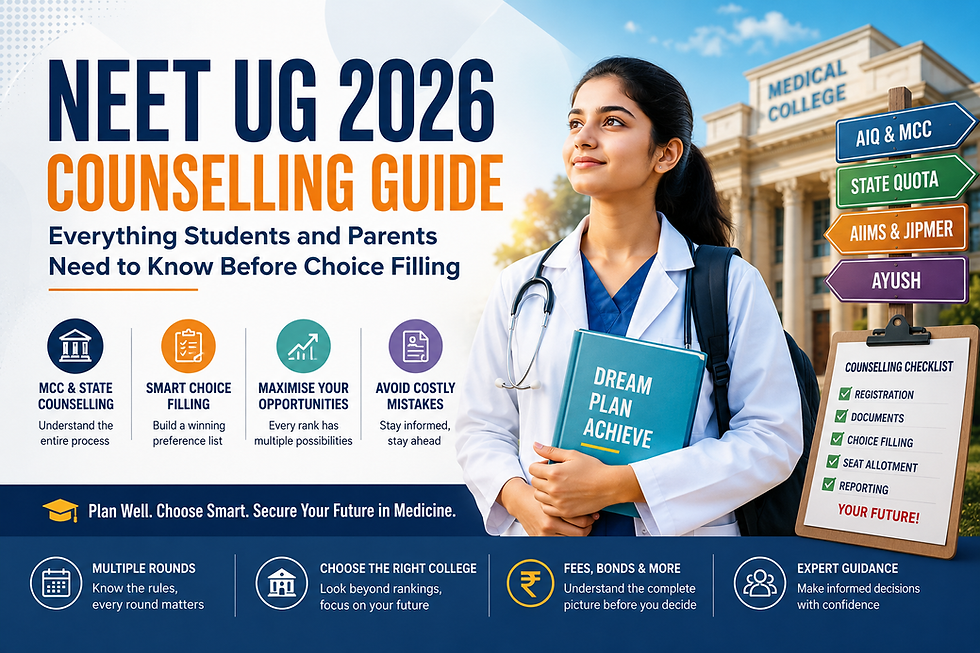
NEET UG 2026 Counselling Guide: Everything Students and Parents Need to Know Before Choice Filling

Updated: Jul 7
Your NEET score opens the door. Your counselling strategy determines which door you walk through.
For nearly two years, lakhs of students dedicate themselves to preparing for NEET. They attend coaching classes, solve thousands of MCQs, sacrifice weekends, and invest countless hours chasing one dream earning a seat in a medical college.
Yet, once the examination is over, many families unknowingly enter an equally critical phase: the NEET UG counselling Guide Process.
Ironically, every year thousands of deserving students fail to secure the best possible college not because of their NEET score, but because of avoidable mistakes during counselling.
Some miss registration deadlines.
Some register on only one counselling portal when they are eligible for multiple counselling processes.
Others submit only a handful of college choices when a much broader and better-planned preference list could have improved their chances.
Many overlook important institutional factors such as fees, service bonds, or clinical exposure until it is too late.
The reality is simple:
A good NEET score creates opportunities. An informed counselling strategy helps convert those opportunities into the right admission.
This article explains the counselling process in a structured and practical manner so that students and parents can make informed decisions with confidence.
Medical Counselling Is More Complex Than Most Families Realise
Unlike many other entrance examinations, NEET counselling is not conducted through a single admission process.
Medical admissions in India involve multiple counselling authorities depending on the institution and the course you wish to pursue.
Broadly, students may participate in:
MCC (Medical Counselling Committee) counselling for the All India Quota, Central Universities, Deemed Universities, AIIMS, JIPMER and other institutions notified by the Government of India.
State Counselling Authorities for State Quota Government Medical Colleges, Private Medical Colleges and, in many states, Management Quota admissions.
AACCC (AYUSH Admissions Central Counselling Committee) for AYUSH courses such as BAMS, BHMS, BUMS, BSMS and BNYS.
Many students participate simultaneously in both MCC and their respective State counselling processes to maximise their admission opportunities.
Understanding which counselling authorities apply to your situation is the first step towards building an effective admission strategy.
AIIMS and JIPMER: An Important Update
One of the most common misconceptions among students and parents is that AIIMS and JIPMER have a completely separate counselling process. This was true several years ago.
Today, MBBS admissions to all AIIMS campuses and JIPMER are conducted through the Medical Counselling Committee (MCC) based on NEET UG ranks.
Students seeking admission to these institutions participate in the same MCC counselling process used for other eligible institutions covered under the MCC framework. Understanding the current admission structure helps students avoid unnecessary confusion during registration.
Your Rank Is Important; But Strategy Matters Too
Parents often ask,
"My child secured AIR 18,000. Which college will they get?"
Unfortunately, there is no simple answer.
Two students with identical NEET ranks can receive admission offers from very different institutions.
Why?
Because admission depends on several interacting factors, including:
All India Rank
Category and reservation eligibility
Home State or domicile
Previous years' admission trends
Choice-filling strategy
Availability of seats
Participation in different counselling rounds
The examination determines your eligibility. Counselling determines how effectively that eligibility is converted into an admission offer.
Choice Filling Is a Strategic Exercise
Perhaps the biggest mistake students make is treating choice filling as a list of favourite colleges. It isn't. A well-prepared preference list should include institutions across three broad categories.
Dream Choices
These are ambitious institutions where previous years' closing ranks were slightly better than your current rank. Cut-offs vary every year, making these worthwhile options.
Target Choices
These are colleges where your rank falls comfortably within historical admission trends.
This should form the core of your preference list.
Safety Choices
These include colleges where admission is historically more likely based on your rank and eligibility. Including sufficient safety options significantly reduces the risk of remaining unallotted. A balanced preference list is almost always stronger than a short list containing only highly competitive institutions.
Counselling Is Dynamic
Many students assume that receiving an allotment automatically ends the admission process. In reality, counselling progresses through multiple rounds.
Depending on the applicable counselling rules, candidates may have opportunities to:
Accept an allotted seat.
Participate in subsequent rounds for possible upgradation.
Exercise available withdrawal options within the prescribed timelines.
However, the rules governing withdrawal, upgradation, reporting and forfeiture vary across counselling authorities and rounds. Students should therefore read the official information bulletin carefully before making any decision.
Don't Ignore BDS
While MBBS receives most of the attention, the Bachelor of Dental Surgery (BDS) is an established professional healthcare degree with excellent long-term career prospects.
Dentists today work across:
Clinical practice
Implantology
Orthodontics
Oral and Maxillofacial Surgery
Cosmetic Dentistry
Academics
Research
Hospital administration
Public health
India is home to several outstanding Government Dental Colleges offering excellent clinical training. Students genuinely interested in dentistry should evaluate BDS as an independent professional career rather than viewing it merely as an alternative to MBBS.
AYUSH Is Becoming an Important Healthcare Career Path
Healthcare today extends well beyond conventional medicine.
Professional programmes such as:
BAMS
BHMS
BUMS
BSMS
BNYS
continue to grow in importance as interest in integrative healthcare, wellness, preventive medicine and traditional systems of medicine expands.
Admissions to these programmes are conducted through the AYUSH counselling process, which requires separate registration under the applicable counselling authority.
Students interested in these courses should monitor both central and state AYUSH counselling notifications.
Document Verification Can Make or Break Your Admission
Many admission problems arise not because of NEET scores but because of incomplete or inconsistent documentation.
Students should carefully verify:
NEET scorecard
Admit card
Class X and XII certificates
Government identity proof
Category certificates (where applicable)
Domicile certificate
Migration certificate
Character certificate
Medical fitness certificate
Passport photographs
One of the most common issues is inconsistency in the spelling of names across different documents. Even minor discrepancies should be resolved well before reporting to the allotted institution. Preparing documentation in advance reduces stress and avoids last-minute complications.
Look Beyond Rankings
Choosing a medical college should never depend solely on rankings.
Students and parents should also evaluate:
Tuition and hostel fees
Clinical exposure
Patient footfall
Faculty strength
Internship opportunities
Research facilities
Postgraduate ecosystem
Infrastructure
Campus environment
Mandatory service bonds, where applicable
Long-term career opportunities
The right college is not necessarily the highest-ranked college. It is the institution that best aligns with your academic goals, financial circumstances and career aspirations.
Common Mistakes Students Should Avoid
Some of the most frequent counselling mistakes include:
Waiting until the last day to register.
Filling too few college preferences.
Ignoring State counselling while focusing only on MCC.
Choosing colleges without researching fees or service obligations.
Missing document verification deadlines.
Relying exclusively on social media rumours instead of official notifications.
Making decisions without understanding the counselling rules.
Most of these mistakes are entirely avoidable with proper planning.
Final Thoughts
Preparing for NEET requires dedication.
Preparing for counselling requires knowledge, planning and sound decision-making.
Students who approach counselling with the same seriousness that they prepared for the examination are often able to identify opportunities that others overlook.
Medical education represents one of the most significant investments a family makes not only financially, but also emotionally and professionally. Take the time to understand the process, verify information from official sources, and make decisions based on careful research rather than assumptions. The right counselling strategy can make a meaningful difference to your admission outcome.
About India Career Centre
At India Career Centre, we help students and parents navigate complex admission processes with clarity and confidence.
Our personalised NEET-UG-Counselling-Guide services assist families in evaluating colleges, understanding counselling procedures, preparing strategic preference lists, and making informed decisions based on each student's NEET rank, category, domicile, budget, and long-term career goals.
Because the right decision is not simply about getting a medical seat, it's about choosing the right institution to begin your journey as a healthcare professional.
Detailed Counselling Guidance is available on request.


Comments