

The Other Side of the EV Revolution


How Electrifying Transport Is Reshaping Electricity, Oil Demand and Emissions
The electric vehicle revolution is usually presented as a straightforward environmental story. Petrol and diesel vehicles burn fossil fuels, produce tailpipe emissions and contribute to urban air pollution, while electric vehicles eliminate tailpipe emissions and use energy far more efficiently. When powered by increasingly clean electricity, EVs can substantially reduce greenhouse-gas emissions over their lifetime.
Yet there is another side to this transition that receives much less attention: an electric vehicle does not eliminate the energy required for transportation; it changes the energy system from which that energy comes.
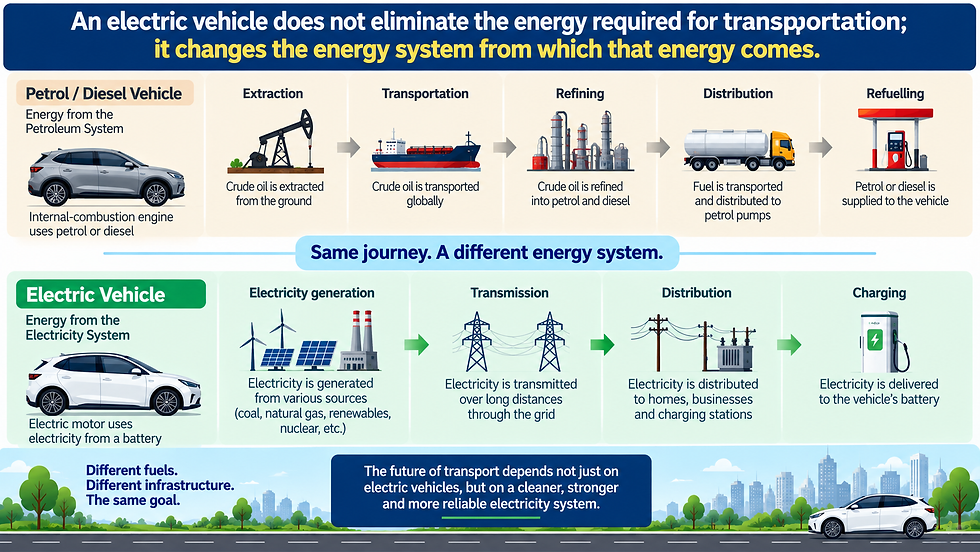
A conventional vehicle draws its energy from the petroleum system. Crude oil is extracted, transported, refined and distributed before petrol or diesel reaches the vehicle. An EV draws its energy from the electricity system, which must generate, transmit, distribute and deliver electricity to the battery. The transition is therefore not simply a change in propulsion technology. It is a shift in the infrastructure that supplies energy for mobility.
The EV is much more efficient, but electricity still matters

Internal-combustion engines waste a large proportion of the energy contained in petrol or diesel as heat, whereas electric motors convert a much larger share of supplied energy into useful mechanical work. Even when some charging electricity comes from fossil fuels, an EV can therefore require substantially less energy per kilometre than a comparable conventional vehicle.
This is why the argument that EVs are not environmentally beneficial simply because their electricity comes partly from coal is incomplete. The relevant comparison is the total energy consumption and emissions over the vehicle's lifetime. The IEA estimates that the global EV fleet avoided around 190 million tonnes of net CO₂-equivalent emissions in 2025, after accounting for emissions from the electricity used to charge the vehicles.
The environmental benefit of an EV is therefore not fixed. As electricity becomes cleaner, the same EV becomes cleaner.
But where does the electricity come from?
The question becomes more important as EV adoption grows. The Energy Institute estimates that global electricity generation reached 32,202 TWh in 2025. Despite rapid renewable expansion, fossil fuels still provided more than half of global electricity, with coal remaining the largest single source.
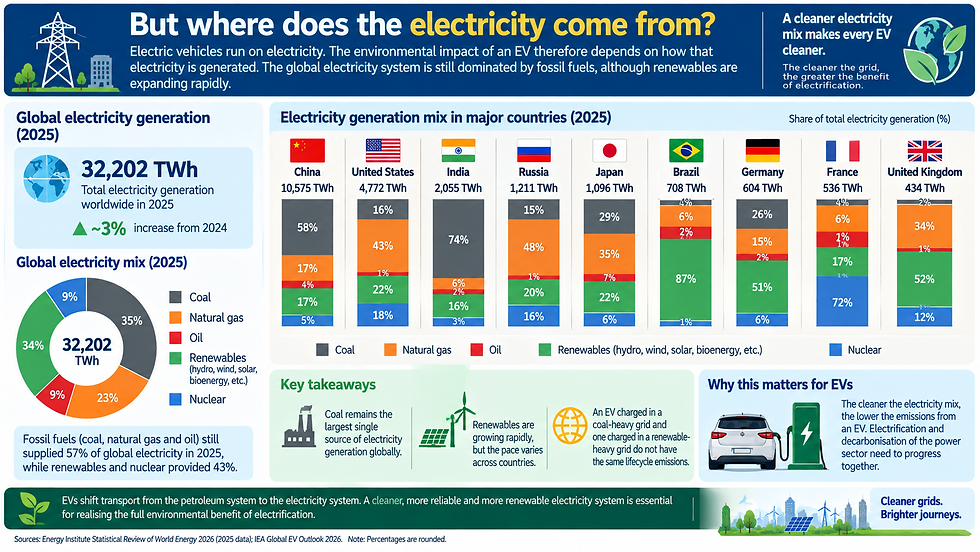
The electricity mix varies enormously. China generated about 10,575 TWh in 2025, with coal still dominant despite rapid renewable growth. The United States generated about 4,772 TWh from a more diversified mix of natural gas, coal, renewables and nuclear power. India generated about 2,055 TWh, with coal providing roughly three-quarters of generation. Brazil's system was dominated by renewables, while France relied heavily on nuclear power alongside renewables.
An EV charged in a coal-heavy system therefore has a different emissions profile from one charged largely from hydro, nuclear or renewable electricity. But fossil-fuel generation does not erase the efficiency advantage of electric propulsion. The bigger question is how quickly electricity systems can become cleaner while meeting rising demand.
The world is not electrifying transport in the same way
Counting EVs alone can also be misleading. An electric scooter, car, three-wheeler, bus and heavy truck have very different battery sizes, annual mileage, electricity consumption and petroleum displacement.

India is a good example. Vahan-based data indicate roughly 2.3 million EV registrations in 2025, but the overwhelming majority were two- and three-wheelers. The IEA estimates that India sold just under 1.3 million electric two-wheelers, almost 800,000 electric three-wheelers and around 165,000 electric cars.
This matters because India's EV transition is occurring heavily through everyday mobility scooters, motorcycles and auto-rickshaws; rather than being driven primarily by passenger cars. Individually, these vehicles consume relatively little electricity, but millions of them travelling thousands of kilometres create a significant cumulative effect.
The transition therefore works in two directions at once: petroleum consumption falls while electricity consumption rises.
EVs are already changing the energy equation
The global scale is significant. More than 20 million electric cars were sold worldwide in 2025, roughly one-quarter of global new-car sales. China alone sold more than 13 million.
At the same time, the IEA estimates that EVs consumed around 250 TWh of electricity in 2025 and displaced approximately 1.7 million barrels of oil per day. Electric cars alone accounted for about 1.2 million barrels per day of displaced oil consumption.
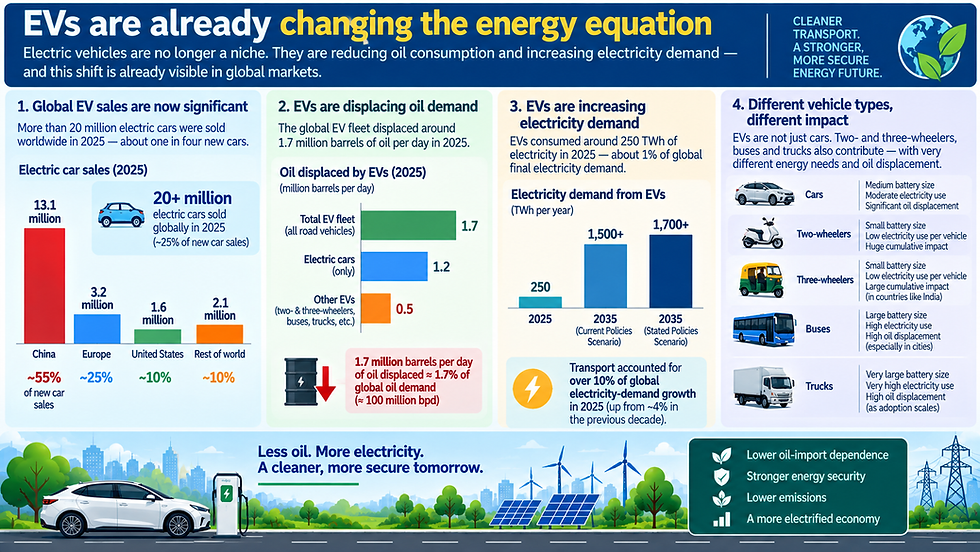
EV electricity demand remains modest compared with global electricity use, but it is growing rapidly. Under the IEA's scenarios, it rises to more than 1,500 TWh by 2035 under current policies and around 1,700 TWh under stated policies.
Transport already accounted for more than 10% of global electricity-demand growth in 2025. As buses, commercial vehicles and trucks electrify, their contribution is likely to become increasingly significant because they travel much greater distances than private vehicles.
The automobile is therefore becoming part of the electricity-demand equation.
India: less oil dependence, more electricity dependence
For India, this shift has an important strategic dimension. Electrifying transport can reduce dependence on imported petroleum while allowing a growing share of transport energy to come from domestic electricity generation.
But dependence does not disappear; it changes form. Instead of asking only how much crude oil India will import, policymakers increasingly need to ask how much additional electricity will be required, where it will be generated, how it will reach consumers and whether local distribution networks can accommodate millions of charging loads.
That could still be a significant advantage. Solar, wind, hydro and nuclear power offer opportunities to increase domestic electricity supply, whereas petroleum has fewer readily scalable substitutes. But the benefit depends on investment in generation, transmission, distribution, storage and charging infrastructure.
More renewable generation is not enough
Adding solar and wind capacity does not by itself solve the electricity challenge. Power has to be available when and where it is needed. Solar generation is concentrated during daylight hours, wind varies with weather, and electricity demand does not necessarily follow either.
This makes storage, transmission, flexible generation, demand management and stronger distribution networks increasingly important. EVs are also only one source of new electricity demand. Air-conditioning, industrial electrification and data centres are creating additional loads.
The IEA estimates that more than 2,500 GW of renewable, storage and large-load projects are currently waiting in grid-connection queues worldwide. Grid investment will need to increase substantially if new generation and new electricity demand are to be connected in time.
A country can therefore have affordable EVs, abundant renewable resources and thousands of charging stations and still face a bottleneck if its grid cannot support the transition.
The weak link may determine how fast EVs scale
This is where Stanford economist Charles I. Jones's “weak links” framework offers an interesting way to think about EV adoption. Jones and Chris Tonetti examine economies and production systems in which multiple complementary tasks must work together. Rapid improvement in most parts of a system does not necessarily eliminate the constraint created by a remaining weak link.

The same logic can be applied to electric mobility. EV adoption depends on a chain of interdependent systems: affordable vehicles, batteries, charging infrastructure, electricity generation, transmission, distribution, financing, maintenance and consumer acceptance.
If one critical link falls behind, it can constrain the wider transition. In one country the weak link may be grid capacity; in another, charging infrastructure or vehicle affordability. Elsewhere, battery supply, financing or after-sales service could become the constraint.
The pace of EV adoption may therefore depend less on how quickly the strongest parts of the ecosystem improve than on how quickly its weakest critical links are strengthened.
The real transition is bigger than the EV
The simplistic version of the EV story is:
Petrol → Electric Vehicle → Cleaner transport
The more complete energy story is:
Fossil energy → Electricity → Cleaner electricity → Lower-carbon mobility
The EV is only one part of a much larger transition. If electricity remains heavily fossil-based, the environmental benefit of electrification is smaller. As electricity becomes cleaner, the same vehicle becomes progressively cleaner over its lifetime.
This means EV policy cannot be separated from electricity policy. Countries pursuing rapid EV adoption must think simultaneously about generation, grids, storage, charging and demand management.
The other side of the EV revolution
The important question is not whether electric vehicles are simply "clean" or "dirty." It is what happens to the energy system when millions of vehicles stop consuming petroleum and start consuming electricity.
The answer is already visible. Petroleum demand falls while electricity demand rises; oil-import dependence can decline while dependence on reliable electricity increases; charging becomes part of transport infrastructure; and the carbon intensity of the electricity system increasingly determines the environmental benefit of electric mobility.
In 2025, the global EV fleet consumed around 250 TWh of electricity, displaced around 1.7 million barrels of oil per day, and avoided approximately 190 million tonnes of net CO₂-equivalent emissions.
These numbers do not mean that EVs have solved the transport-energy problem. They show that the problem is moving; from the petroleum system towards the electricity system.
For India, that shift could be particularly significant because millions of two- and three-wheelers are already making that transition. Their individual electricity consumption may be modest, but their cumulative impact is significant: less petroleum consumed on one side and more electricity required on the other.
The future of clean transportation will therefore depend not only on how quickly petrol and diesel vehicles are replaced, but on how quickly countries can build electricity systems capable of powering that replacement with reliable, affordable and increasingly clean power.
The visible revolution is happening on the road. The more consequential transformation may be happening behind the charging socket.
Comments