

Top 10 Questions Asked by 11th and 12th Grade Students

I was invited for a career counselling session for the 11th and 12th Grade students recently by a school in Nigeria, Indian Language School, Lagos.
Here are the top 10 questions asked by the students from 11th and 12th Grade, which I guess may be similar for most of the Indian students across India and overseas locations.
Question: At 16–18, we don't know ourselves well enough. How can we make a good career decision when we don't yet know our true interests and strengths?
Answer: This is honestly the most common question we get, and I want to validate it first: you're right. At 16–18 you genuinely don't have enough data on yourself yet. That's not a flaw in you, it's just true of every 17-year-old in history.
So, here's a practical path, not a leap of faith.

Start with your school subjects, notice what you actually enjoy and do well in, not what you're 'supposed' to enjoy. Use that to pick a broad career path, not a narrow one. Your undergraduate degree, three to five years, gives you broad exposure across subjects within that path. Only after that do you narrow into a specialization, once your actual professional path has emerged from real experience.
Notice what this removes: the pressure to know your 'true calling' at 17. You don't need to. You need to pick a broad enough door that many rooms are still open behind it.
Question: How can we distinguish between a career we genuinely want and one we've been conditioned to want by parents, peers, social media and trends?
Answer: Very relevant question, and there's a simple test for this.

Remove the audience. Imagine no one, not your parents, not your peers, not Instagram would ever know what you chose. Now ask yourself honestly: would you still want it?
If yes, that's likely genuine desire. The pull stands on its own, without anyone watching. If the answer starts involving other people's reactions, 'but what will people say,' 'but my family expects', that's likely conditioning.
It needs an audience to feel right. This one test won't solve everything, but it's a fast, honest gut-check you can run on any career option in thirty seconds.
Question: We are told to follow our interests. How can we practically test whether an interest is actually suited to us before committing to a career?
Answer: 'Follow your passion' is genuinely bad advice on its own, it's untestable. Here's how to make it testable.

First, notice an interest emerge. something you keep coming back to, unprompted, over time. Then stress-test it, don't just admire it from a distance. Take a course, get a certification, do an internship in it. Put it under real pressure with real deadlines and real difficulty.
If it survives that stress test, it's likely suited to you, worth committing to further. If it doesn't survive contact with the actual work, it was likely just a passing phase and that's fine, let it go naturally and move on. The stress test is the difference between a hobby and a vocation.
Question: What are the most important factors to consider when choosing a career; interest, aptitude, opportunity, income, stability, lifestyle, or something else?
Answer: People usually list these six factors as if they're all equal and you should balance
them. We disagree.
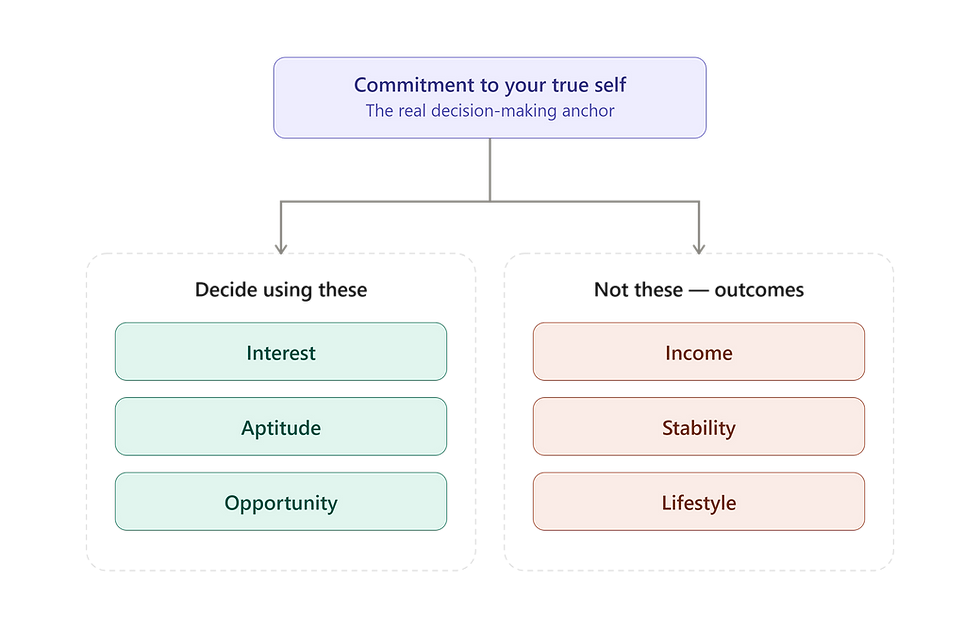
Your commitment to your true self is the real decision-making anchor. And that gets built from three factors: interest, aptitude, and opportunity. These are inputs, things you can act on directly.
Income, stability, and lifestyle are not decision inputs, they're outcomes. They follow from doing something you're genuinely good at and genuinely interested in, applied where there's real opportunity. If you try to decide based on income or stability directly, you're optimizing for an outcome instead of building the thing that produces it.
Question: How important is it to specialize early versus exploring different possibilities before making a decision?
Answer: The honest answer is: it depends on you, specifically, not on some universal rule.

Ask yourself: how much clarity do I actually have right now about what I want to become?
If you have high clarity, you already know, with confidence, then specialize early. There's no virtue in artificially delaying a decision you're genuinely sure about.
If you have low clarity and remember, that's completely normal at your age, then explore widely first, and narrow later. Either path can get you to the right career. The mistake is picking the wrong strategy for your actual clarity level, forcing early specialization onto genuine uncertainty, or forcing endless exploration onto a decision you've already made.
Question: With so many new careers emerging, should students still consider traditional choices such as medicine and engineering?
Answer: Yes, medicine and engineering absolutely still matter. But I want to give you some perspective on scale, because this question usually comes from a place of feeling like there are only two 'safe' paths.

Medicine and engineering are two paths among thousands. The US Department of Labour tracks over 900 distinct occupations. India's Ministry of Labour tracks over 3,600. The European Union tracks over 3,000.
So the real advice is: focus on your interest and strength first, and then explore the paths that exist within that space, which may well include medicine or engineering, but might also include dozens of adjacent, newer options you've never heard of because nobody in your family has done them yet.
Question: If I prepare for a career and later realise it isn't right for me, have I made a mistake and what should I do?
Answer: No. And I want to say that plainly, because the fear of 'wasting years' stops a lot of good decisions.

It's not a mistake, careers span 40 to 50 working years. A few years spent on a path that didn't work out is a small fraction of that timeline, not a catastrophe.
Change comes from many places, the market shifts, technology shifts, your own interests genuinely evolve, family circumstances change, sometimes it's just chance. That's normal, not a personal failure.
The practical move: pivot close to your domain. The shorter the distance between where you are and where you're going, the less effort the pivot takes, your existing skills and knowledge carry over rather than being thrown away.
Question: If AI significantly changes my chosen industry over the next 10 years, how should I future-proof my career?
Answer: Four things, in order.

Accept that AI will impact you; not if, but how. Denial is the most expensive mistake here.
Learn the relevant tools; stay current in whatever your chosen path is; the tools will keep changing and that's now a permanent feature of work, not a phase.
Stay humble and adaptable; today's edge disappears with the next version. Treat your current skill set as temporary by design.
Double down on human-centric work; judgment, empathy, complex communication, trust. That's the part of the job AI struggles to replace, and it's worth investing in deliberately, not as an afterthought.
Question: What should a student actually do between Class 11 and entering university to make a better career decision, courses, projects, internships, shadowing, conversations, etc.?
Answer: All of the above can help; courses, projects, internships, shadowing, conversations with people already doing the work.

But the activity itself isn't what matters most. What matters is the filter you run it through afterward: was this chosen from genuine interest?
If yes, it builds your actual profile, adds real domain expertise, and compounds over time. If no, if you did it to copy a peer or to conform to what looks good on an application, it's just conformity, and it's largely wasted motion, even though it looks identical on paper to the genuine version.
Same activity, same certificate, completely different value, depending on why you did it.
Question: How should students balance passion with employability, income and job security?
Answer: This is often the hardest one for families, so let's be honest about it.

The real first question isn't about the student, it's: can the family support the passion path, especially if it's unconventional? Because that changes the timeline, not the validity of the passion itself.
If yes, pursue it now. It may just take longer to stabilize financially, and that's a timeline problem, not a wrong-choice problem.
If not yet, pick a path near another one of your strengths, something adjacent that gives you financial ground to stand on. Keep the passion alive as a serious pursuit on the side, and pivot into it fully once you're self-sufficient. This is not giving up on the passion, it's sequencing it responsibly.
I hope this helps students, parents and career counsellors at schools helps the students to take the right the career decisions at the appropriate time in their high/higher secondary school.
About the Author:
Dr SP Mishra is the Founder of India Career Centre, a Hyderabad-based career guidance, study-abroad consulting and educational research organisation. He writes and speaks on career decision-making, higher education, skills, employability and the future of work in India. Also hosts the India Career Centre Podcast. Connect on LinkedIn.


Comments