

Why Smart Graduates Are Struggling to Get Jobs in 2026

Here are some of the typical questions related job users are asking on the google in India.
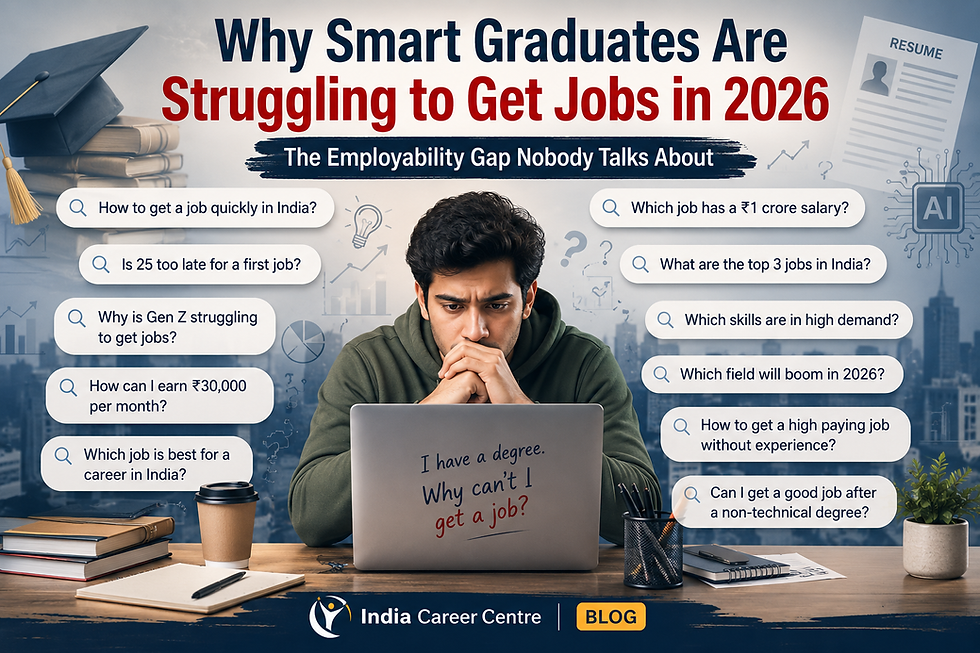
"How to get a job quickly in India?"
"Is 25 too late for a first job?"
"Why is Gen Z struggling to get jobs?"
"How can I earn ₹30,000 per month?"
"Which job is best for a career in India?"
"Which job has a ₹1 crore salary?"
These are among the questions thousands of Indians ask Google every day.
While the wording differs, the underlying concern is the same:
"I studied hard. Why does getting a good job still seem so difficult?"
For decades, students were taught a simple formula:
Study hard → Get good marks → Earn a degree → Get a job.
For many families, this was not merely advice—it was accepted as fact.
Yet in 2026, something doesn't add up.
Many graduates are struggling to secure meaningful employment, while employers continue to complain about a shortage of suitable talent.
How can both be true?
The answer lies in a reality that many students discover only after graduation:
The world of work has changed, but much of our career preparation has not.
The Employability Gap in Jobs
India is not facing a shortage of graduates. India is facing a shortage of graduates who can immediately contribute in the workplace. This difference is crucial.
A degree certifies that a student has completed a course of study.
Employability, however, is the ability to create value in a professional environment.
The gap between these two concepts is where many graduates struggle.
Five major forces are widening this gap.
1. Skills Mismatch: Learning About Work vs Doing Work
Many academic programs continue to prioritize knowledge acquisition. Employers increasingly prioritize problem-solving ability.
A student may know the theory of marketing, but can they design a digital campaign?
A student may understand programming concepts, but can they build a usable application?
A student may study finance, but can they interpret data and recommend business decisions?
The modern workplace rewards application, execution, and adaptability. Unfortunately, these are not always the skills that traditional education systems emphasize.
2. Degree Inflation: When Everyone Has Similar Credentials
A bachelor's degree once differentiated a candidate. Today, millions of graduates possess similar qualifications. As access to higher education expands, employers have naturally started looking beyond degrees.
Increasingly, organizations evaluate:
Projects
Internships
Portfolios
Certifications
Leadership experiences
Evidence of initiative
A degree remains important. But it is no longer sufficient.
Many graduates enter the job market believing their qualification is their competitive advantage. Only later do they discover that it is simply the entry ticket.
3. AI Is Changing the Rules Faster Than Colleges Can Adapt
Artificial Intelligence is reshaping work across industries. The impact is not limited to technology companies.
Marketing, finance, design, healthcare, education, and countless other fields are being transformed.
The question is no longer:
"Will AI replace jobs?"
The more useful question is:
"What value can I create that AI cannot easily replicate?"
The most valuable professionals will increasingly be those who combine domain expertise with:
Critical thinking
Creativity
Judgment
Collaboration
Communication
AI is becoming a powerful tool. Those who learn to use it effectively will gain an advantage. Those who ignore it may find themselves competing against people who can do more, faster, and better.
4. Communication Skill has Become Career Skill
One of the most common employer complaints has little to do with technical knowledge.
It has to do with communication.
Many capable graduates struggle to:
Express ideas clearly
Present confidently
Write professionally
Participate in discussions
Handle interviews effectively
In today's workplace, your ideas create value only when others can understand them.
Communication is not a soft skill. It is a professional skill.
And in many cases, it is the difference between getting shortlisted and getting overlooked.
5. The Experience Paradox
Graduates often encounter a frustrating contradiction:
Employers want experience.
Graduates need jobs to gain experience.
This appears unfair, but the definition of experience is evolving.
Employers increasingly value:
Internships
Freelancing
Volunteer work
Student leadership
Independent projects
Entrepreneurial initiatives
The graduates who stand out are often those who create opportunities rather than waiting for them. Experience is no longer limited to formal employment.
It is evidence that you can apply your skills in the real world.
The Real Problem: We Are Preparing Students for Yesterday's World
Perhaps the biggest issue is not unemployment. It is outdated assumptions.
Many students continue to prepare for a world where:
Degrees guaranteed opportunities.
Careers were predictable.
Skills remained relevant for decades.
Learning ended after graduation.
That world is disappearing.
Today's reality looks different:
Yesterday | Today |
Qualification-centric | Capability-centric |
Knowledge-focused | Application-focused |
Fixed careers | Evolving careers |
One-time education | Lifelong learning |
Job security | Employability security |
The graduates who thrive will not necessarily be those with the highest marks.
They will be those who learn continuously, adapt quickly, and demonstrate value consistently.
What Students Should Focus On Instead
Rather than asking:
"Which degree is safest?"
Students may benefit from asking:
What problems can I solve?
What skills are becoming valuable?
What evidence can I show of my capabilities?
How can I gain practical experience?
How can I continue learning after graduation?
These questions are more difficult. But they are also more useful.
Final Thoughts
The questions appearing on Google are symptoms of a deeper issue. Students are searching for certainty in an increasingly uncertain world. Unfortunately, there are no longer any perfectly safe options. There are only informed decisions.
The future will belong to individuals who are willing to move beyond marks, myths, and conventional assumptions about careers.
Because employers are no longer hiring qualifications alone. They are hiring people who can learn, adapt, solve problems, and create value. And that is ultimately what employability has always been about.
Reflection Question
If your degree disappeared from your résumé tomorrow, what evidence would remain to convince an employer to hire you?
The answer to that question may tell you more about your career readiness than any examination result ever could.


Comments