

Global Education: When Welcome Becomes Conditional

How Global Immigration Tensions Are Reshaping International Education?

Studying abroad can open a world of possibilities. But should a family's investment in education depend on the hope of eventually settling in another country?
For generations of Indian students, studying abroad has represented more than obtaining a degree. It has offered exposure to different cultures, access to international networks and the possibility of building a global career. Families have spent years saving, taken education loans and made considerable sacrifices to give their children this opportunity.
Traditionally, the decision revolved around a few questions: Which university? Which course? What will it cost? What are the employment prospects after graduation?
Today, another question has become increasingly important: Will the opportunities I expect still be available when I graduate?
From the United States and the United Kingdom to Canada, Australia and Europe, immigration policies and public debates about migration are changing the environment in which international students make their plans. Post-study work opportunities, visa conditions and pathways to permanent residence can change during the years a student spends preparing for and completing a degree.
This does not mean that international students are unwelcome everywhere. Nor should protests against immigration be mistaken for protests against students. But the broader uncertainty raises an important question for Indian families: are we investing in an education, or are we investing in the hope of eventually settling abroad?
This question builds on a principle I have explored in my earlier guide to undergraduate education abroad for Indian students and parents: the objective should not simply be to study abroad, but to choose an educational pathway that best supports the student's future goals.
Indian families are recalculating
The changing environment is already influencing student preferences.
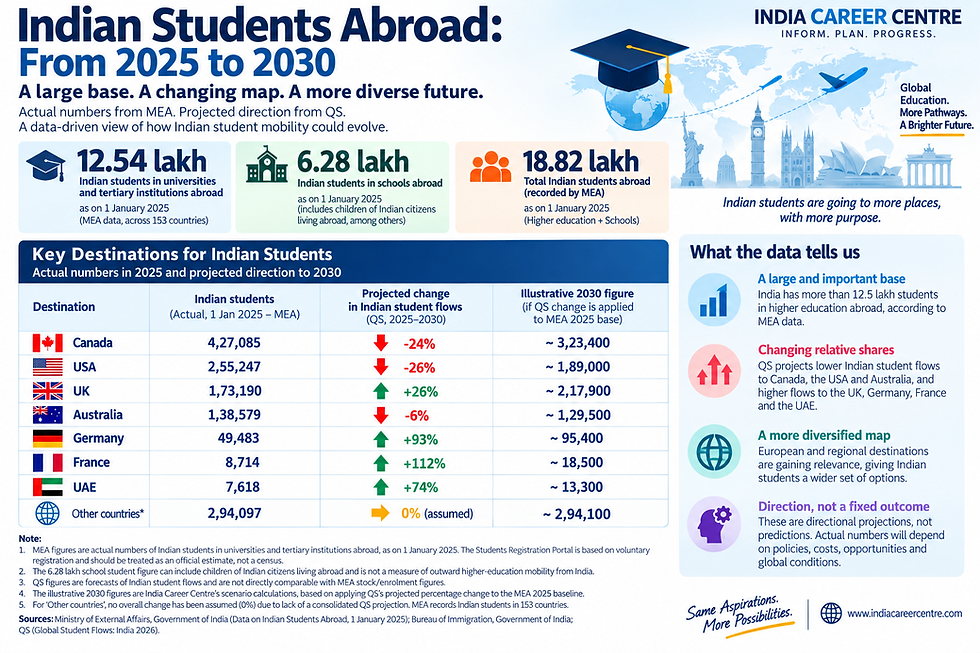
An ICEF Monitor analysis published in July 2026 reported that 5.5% fewer Indians studied abroad in 2025, although approximately 1.2 million Indian students remained enrolled in foreign universities. Visa difficulties, rising costs and uncertainty around post-study work opportunities are among the factors influencing decisions.
A survey in Emeritus's India's Gen Z Outlook 2026, reported by The Indian Express, found that 48% of respondents aged 15–28 who had considered studying abroad reported reduced interest compared with the previous year. The survey covered 1,010 respondents in major Indian cities and measured stated preferences rather than actual enrolment, so the findings should be treated as an indicator rather than a verdict.
These changes cannot be attributed to immigration tensions alone. Costs, visa restrictions, employment prospects and individual circumstances all play a role.
Nevertheless, students and parents have good reason to reassess their assumptions. An overseas degree costing ₹40 lakh, ₹60 lakh or more is a substantial investment. Its value should not depend entirely on whether a student can secure a job, extend a visa and eventually obtain permanent residence.
Education first; immigration as a separate decision
Perhaps we need to rethink what we expect from international education.
Studying in another country offers opportunities to encounter different academic traditions, understand unfamiliar cultures, become more independent and build relationships with people from across the world. It can develop professional skills, confidence and the ability to work across cultures.
These benefits do not disappear when the course ends or when a student returns to India.
The knowledge gained, the people met, the experiences accumulated and the professional networks established can remain valuable throughout a career, whether that career unfolds in India, the country of study or somewhere else.
An international degree should be worth pursuing even if the student eventually returns home.
This is not an argument against immigration. Nor does it mean that students should ignore post-study work opportunities. Gaining international work experience can be valuable, and the availability of such opportunities should form part of the decision.
The distinction is that employment and immigration should be treated as possibilities, not promises on which the entire educational investment depends.
Immigration rules can change. Job markets can weaken. A graduate may discover that suitable employment is harder to find than expected. None of these outcomes necessarily makes the education itself worthless.
A student returning to India with a recognised qualification, international exposure, relevant skills and professional relationships has not automatically failed to realise the value of the investment.
The question is whether the education has prepared the student for a meaningful future, rather than whether it has delivered one particular outcome: permanent settlement abroad.
The financial calculation must work, too
This distinction has important implications for parents.
When families plan overseas education, they often consider the tuition fees, living expenses and expected salary after graduation. Sometimes, the financial calculation also assumes several years of overseas employment or eventual permanent residence.
That assumption deserves closer examination.
What happens if the student returns to India immediately after graduation? What if finding a suitable job takes longer than expected? Would the family still consider the investment worthwhile if the graduate earns an Indian salary rather than an overseas one?
These are not pessimistic questions. They are essential when the decision involves years of family savings or a substantial education loan.
Parents should assess the total cost of education against what they can reasonably afford and the value the qualification can deliver across different possible outcomes. They should examine whether the degree is recognised in India, whether its skills are transferable and whether the expected benefits justify the cost compared with suitable programmes available at home.
If the financial plan works only when every employment and immigration expectation is fulfilled, the family may be taking on more risk than it realises.
A more resilient plan allows the student to benefit from the overseas experience without carrying the emotional burden of having to settle abroad to justify the family's sacrifice.
In my earlier guides to studying in the USA and Canada and pursuing a Master's degree in Europe and the UK, I have examined the importance of aligning career aspirations with financial capacity, programme quality and post-study opportunities. These considerations become even more important when immigration rules can change during the period of study.
The questions students and parents should ask
Before choosing a destination, families should look beyond university rankings and recruitment promises.
They should ask whether the course offers the knowledge and skills the student needs, whether the total cost is financially manageable, what the current visa and post-study work rules permit, and what happens if the expected job does not materialise.
Most importantly, they should consider whether the qualification will remain valuable if the student returns to India or pursues a career in another country.
The purpose is not to predict every possible change in immigration policy. That is impossible. It is to make sure that one uncertain outcome does not determine the success or failure of the entire plan.
An overseas education should expand a student's options, not leave the family financially or emotionally dependent on a single country allowing the graduate to stay.
A global education, without a single prescribed destination
The recent changes in immigration policies across major destinations do not mean that Indian students should abandon their aspirations of studying abroad. International education can remain a transformative experience.
But familiar destinations should not be chosen simply because they were popular with previous generations. Nor should the prospect of permanent residence outweigh the academic quality of a programme, its affordability or its relevance to the student's long-term goals.
Students may find that a degree delivered partly in India, a joint programme or a less traditional international destination better meets their needs. The right choice depends on the course, the student's interests, the family's finances and the opportunities the qualification can create.
The objective is not to avoid uncertainty altogether. It is to avoid making an expensive, long-term decision on the assumption that the world will remain unchanged.
Ultimately, international education should be an investment in the student's capabilities and understanding of the world, not merely a route to another country's immigration system.
Perhaps the most resilient way to plan an international education is to prepare for a global future without making that future dependent on a single country's willingness to let us stay.
International education must also be viewed alongside the opportunities available at home. As I argued in India Wants to Be a Global Education Hub, education becomes more valuable when it connects knowledge and skills with meaningful opportunities. The same principle applies to Indian students going abroad: the value of what they learn should endure, regardless of where they eventually build their careers.
An overseas degree should give young people more choices, not make one particular outcome the only acceptable measure of success.
Sources and further reading


Comments