

Study Abroad 2030: How Indian Students Are Rethinking the World

India's overseas education landscape is evolving. The number of Indians studying abroad has decreased since the post-pandemic peak, and the range of destinations is expanding. Students and parents are now focusing on which education and career pathway suits the individual, rather than just choosing a country.
For over a decade, studying abroad was a key aspiration for India's middle class, primarily targeting the US, Canada, the UK, and Australia. While these countries still attract many Indian students, factors like immigration policies, affordability, and post-study job opportunities, along with new destinations, are influencing decisions.
This trend is not a retreat from international education but indicates a more selective, diversified, and economically conscious approach, with students evaluating the entire education-to-career pathway more thoroughly.
India still has a large overseas higher-education footprint
As of 1 January 2025, the Ministry of External Affairs recorded 12,54,013 Indian students in universities across 153 countries. This is an estimate, as registration is voluntary. The annual movement of students is more telling: Bureau of Immigration data shows 9,08,364 Indians traveled abroad for education in 2023, 7,70,127 in 2024, and 6,26,606 in 2025, a 31% decline over two years. This flow depends on evolving policies in study-abroad destinations, such as visa regulations and post-study opportunities. The MEA figure is a stock, while immigration figures are the annual flow. The decline in flow doesn't imply a 31% drop in the existing student population abroad. The key trend is the changing selectivity and attractiveness of study destinations.
The traditional four remain dominant, but the balance is shifting
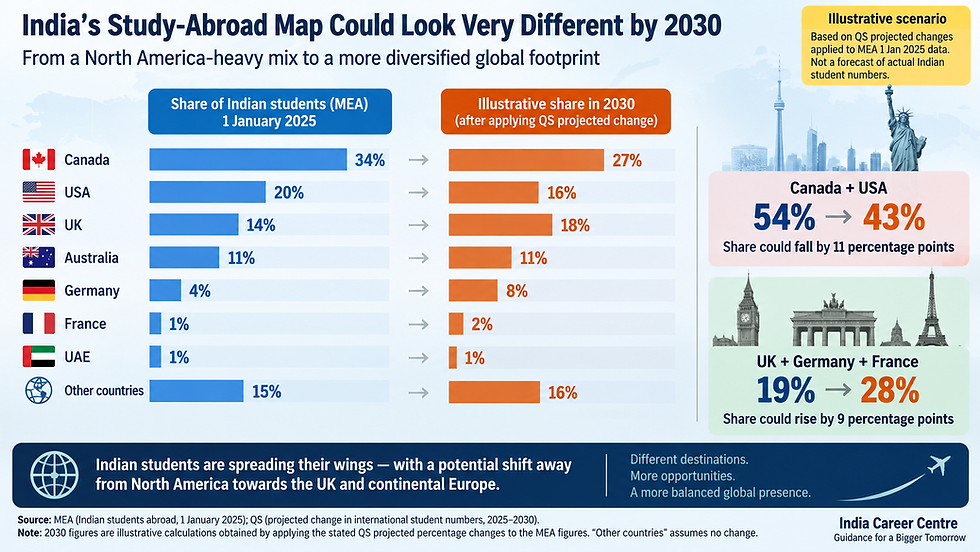
In January 2025, MEA data shows Canada hosted 4,27,085 Indian students, followed by the United States with 2,55,247, the United Kingdom with 1,73,190, and Australia with 1,38,579. These countries account for a significant portion of India's overseas students.
The outlook towards 2030 suggests changes in these positions. QS forecasts indicate the UK will gain ground, Canada and the US will lose ground, and Germany, France, the UAE, and other Asian destinations will grow in relevance.

The QS data, using different methodologies, projects student flows rather than MEA's recorded numbers. We use MEA's 2025 data as a baseline and apply QS's forecasted percentage changes to show potential distribution shifts.
For example, QS predicts a 24% decline in Canadian student flows from 232,900 in 2025 to 176,400 in 2030. Applying this to MEA's 2025 figure of 4,27,085, we estimate an illustrative 2030 figure of about 3.23 lakh. This method applies to other forecasted destinations.
For countries without specific QS forecasts, we assume no change, keeping the "Other countries" category at its 2025 level of 1,94,097. This is an assumption by India Career Centre, not a QS forecast.
India's major destinations: actual 2025 baseline and illustrative 2030 scenario

The final column should not be interpreted as an official prediction of the number of Indian students who will be in these countries in 2030. It is an illustrative scenario created by India Career Centre by applying the percentage change embedded in QS's destination forecasts to the MEA's actual January 2025 baseline. This approach allows the actual Government of India numbers to remain the starting point while still illustrating the potential direction of change suggested by QS.
The resulting scenario is particularly interesting because it suggests that even if India's overall overseas higher-education population does not expand dramatically, the composition of that population could change considerably. Canada and the United States would remain major destinations but at lower levels than their 2025 baseline, while the UK and Germany would become relatively more prominent. France and the UAE would also increase their presence from smaller bases.
Canada and the US: still major destinations, but more complicated choices
Canada's appeal as a destination for Indian students was driven by accessible education and clear pathways to employment and immigration. However, tighter study-permit controls, caps on international students, changes to post-study work rules, and higher living costs have altered this appeal. QS attributes these policy changes to a projected decline in Indian student numbers, though Canada remains a key destination due to its large Indian student population and robust educational offerings.
The United States remains crucial for students in fields like engineering, computer science, and management, offering unmatched academic and research opportunities. However, high tuition fees, living expenses, visa uncertainties, and complex post-study employment rules make financial and career planning more challenging.
For both countries, decisions now need to consider more than just admission prospects. Students and families must evaluate the total program cost, employment opportunities, regulatory conditions, and long-term career paths.
The UK may be the exception among the traditional destinations
The United Kingdom contrasts with the projected decline for Canada, the United States, and Australia. QS forecasts Indian student flows to the UK will rise from 146,500 in 2025 to 184,300 by 2030, a 26% increase. The UK's established universities, short postgraduate programs, and global recognition attract Indian students, suggesting destination choice is not just moving away from traditional English-speaking countries but involves more careful differentiation. However, changes in immigration and dependant policies mean a British degree does not guarantee specific employment or settlement outcomes, making the full education-to-career pathway a key consideration.
Germany's rise could be one of the most significant changes
Germany is emerging as a key destination for Indian students, with QS forecasting an increase from 58,800 in 2025 to 113,300 in 2030, a 93% rise. Germany's strong reputation in engineering, technology, and its demand for skilled professionals attract Indian students interested in STEM careers. This appeal goes beyond tuition costs, offering a unique education-to-career ecosystem. If trends continue, Germany could become significantly more important in India's overseas education landscape by 2030.
France and the wider European opportunity
France exemplifies how the international education map could expand, with QS predicting Indian student numbers rising from 9,100 in 2025 to 19,300 in 2030.
Other European destinations like Ireland and Italy are also expected to grow. However, Europe should not be seen as a single study destination, as each country has unique education systems, language requirements, tuition structures, labor markets, and immigration policies. This diversity adds complexity but offers more credible options, allowing students to find varied combinations of academic quality, affordability, and employment opportunities across Europe.
Beyond Europe, the map continues to expand
Indian student mobility is diversifying beyond Europe. QS predicts Indian student numbers in the UAE will rise from 12,700 in 2025 to 22,100 by 2030, a 74% increase. Malaysia, Singapore, Taiwan, and South Korea are also becoming more relevant. While they won't surpass the US or Canada soon, they offer additional pathways. Geographical proximity, lower costs, regional business exposure, and access to growing economies make these destinations attractive alternatives to North America, the UK, or Australia. The expanding destination map provides Indian students with more credible options to consider.
The economics of an overseas degree is becoming central
An overseas degree is a significant financial commitment for Indian families, encompassing more than just tuition fees. Factors like accommodation, insurance, travel, currency changes, visa costs, part-time work opportunities, scholarships, program duration, and employment prospects after graduation affect the actual cost and return on investment.
Lower tuition doesn't always mean lower total costs, and a higher-ranked university doesn't guarantee better financial returns for every student or program.
Key questions include: what is the family paying, what skills will the student gain, what job opportunities are likely, and how does this compare to options in India or other countries?
This is crucial when the main reason for studying abroad is employment, as the value of an international degree is linked to the labor market the student plans to enter.
International education no longer necessarily means leaving India
Structural changes are reshaping the study-abroad landscape, with internationalisation increasingly occurring within India. Foreign universities are setting up campuses and partnerships in India, while Indian institutions are expanding internationally. QS predicts that transnational education and international branch campuses will significantly impact student mobility by 2030. This development could offer new pathways, such as completing an international degree in India, studying abroad for a semester or year, or pursuing an Indian undergraduate degree followed by an overseas postgraduate program. These options enhance the concept of international education and are appealing for families concerned about the cost, distance, or immigration uncertainties of a full overseas degree.
The real challenge is decision complexity
A decade ago, information scarcity was a major constraint. Today, students have access to vast information through university websites, rankings, social media, alumni experiences, consultants, and AI recommendations. The challenge is determining which information is relevant to each student.
Students with different interests and financial situations need tailored options. For example, a student strong in math with an interest in engineering and a limited budget will have different needs than one interested in finance, design, or hospitality. Even students with similar academic profiles may require different recommendations due to varying financial circumstances, career goals, and risk tolerance.
This shifts study-abroad counselling from application support to structured decision-making. The goal is to assess whether the program, university, country, cost, and career path align for the student.
From choosing a country to choosing a pathway
Starting with a specific country and then looking for universities there can lead to a limited decision. A more effective approach begins with the student: their academic interests, abilities, career ambitions, financial limitations, and preferred learning environment.
The next step involves identifying the programs and skills that align with these goals. Countries and universities can then be evaluated based on academic quality, cost, employability, immigration policies, post-study opportunities, and long-term career prospects.
This approach widens the range of options available. Countries like Germany, France, Singapore, or the UAE may become relevant if they align with the student's objectives. An international university campus in India, followed by postgraduate studies abroad, might be more suitable for some students than leaving India immediately after school.
The growing number of choices makes structured decision-making more crucial, not less.
What could Study Abroad 2030 look like?
India has an estimated 12.5 lakh students in universities and tertiary institutions abroad, according to the latest MEA data. However, the annual number of Indians traveling abroad for education has decreased from 9.08 lakh in 2023 to 6.26 lakh in 2025.
The overseas education market is becoming more complex. While the number of students abroad remains high, the annual flow has slowed. Students face changing immigration policies, higher costs, and a wider range of options.
The QS outlook indicates that the UK, Germany, France, and the UAE could become stronger destinations, with Asian countries also gaining relevance. International branch campuses and transnational education may offer more students international exposure without moving abroad for an entire degree.
Study Abroad 2030 will focus on a more diverse and carefully evaluated pattern of international education rather than just increasing numbers of students leaving India.
For students and families, more choices mean more opportunities but also more complex decisions. The focus should be on the student's goals, desired skills, career aspirations, and family budget, making the choice of country and university more meaningful.
India's study-abroad narrative is shifting from the number of students leaving to how they evaluate education, careers, costs, geography, and opportunities in the global higher-education market.
Sources
Ministry of External Affairs, Government of India, Data on Indian Students Abroad, as on 1 January 2025.
Ministry of External Affairs / Ministry of Education / Bureau of Immigration, Government of India, data on Indians travelling abroad with Study/Education as their declared purpose, 2023–2025.
QS, Global Student Flows: India and The Top Study Destinations for Indian Students by 2030.
Further reading from India Career Centre
Study Abroad Planning: Why Students Need More Than Just University Applications
Masters in USA & Canada: A Decision-Making Guide for Indian Students
Masters in Europe & the UK: A Decision-Making Guide for Indian Students
Masters in Australia & New Zealand: A Decision-Making Guide for Indian Students
Undergraduate Education Abroad: A Decision-Making Guide for Indian Students & Parents
American Higher Education in 2026: What Indian Students Actually Need to Know
Australia's 462 Work and Holiday Visa for Indians: Explore First, Commit Later
About the Author:
Dr SP Mishra is the Founder of India Career Centre, a Hyderabad-based career guidance, study-abroad consulting and educational research organisation. He writes and speaks on career decision-making, higher education, skills, employability and the future of work in India. Also hosts the India Career Centre Podcast. Connect on LinkedIn.
Comments